
In 1573 King Philip of Spain (1527-1598), whose reign represented the height of Spanish global imperial power, released the following statute as a reinterpretation and reframing of the past, present, and envisaged future expansion of his royal and Catholic religious power. How does language relating to peace, pacification, and native conversion speak to the practices and ideologies of Christian empire in the early modern period?
SOURCE: Ordenanzas de Su Magestad para los nuevos descubrimientos, conquistas y pacificaciones—Julio de 1573, “Colección de documentos inéditos relativos al descubrimiento, conquista y organización de las antiguas posesiones españolas de América y Oceanía, sacados de los archivos del reino y muy especialmente de Indias” (Madrid, 1864-1884), 16:142-87. Trans. and ed. Lewis Hanke, History of Latin American Civilization, 2nd ed. (Boston: Little, Brown and Company, 1973), 1:111-14.
Discoveries are not to be called conquests. Since we wish them to be carried out peacefully and charitably, we do not want the use of the term “conquest” to offer any excuse for the employment of force or the causing of injury to the Indians….
After a town has been laid out and its buildings constructed, but not before, the government and settlers are to attempt peacefully to win all the natives of the region over to the Holy Church and obedience to our rule. In his they are to show great diligence and holy zeal and to use the best means at their disposal, including the following:
They are to gather information about the various tribes, languages, and divisions of the Indians in the province and about the lords whom they obey. They are to seek friendship with them through trade and barter, showing them great love and tenderness and giving them objects to which they will take a liking. Without displaying any greed for the possessions of the Indians, they are to establish friendship and cooperation with the lords and nobles who seem most likely to be of assistance in the pacification of the land.
Once peace and amity with the Indians have been assured, the Spaniards will try to bring them together in one spot. Then the preachers, with as much solemnity as possible, will start to teach our Holy Faith to those who wish to be instructed in it, using prudence and discretion and the gentlest methods possible. Accordingly, they are not to begin by rebuking the Indians for their vices and idolatry, nor by taking away their women and idols, so that they will not be shocked and form an aversion to Christian doctrine. Instead, it should be taught to them first, and after they have been instructed in it, they should be persuaded to give up of their own free will those things that are contrary to our Holy Catholic Faith and evangelical doctrine.
The Indians should be brought to an understanding of the position and authority which God has given us and of our zeal in serving Him by bringing to His Holy Catholic Faith all the natives of the Western Indies. They should also learn of the fleets and armies that we have sent and still send for this purpose, as well as of the many provinces and nations that have rendered us obedience and of the many benefits which they have received and are receiving as a result, especially that we have sent ecclesiastics who have taught them the Christian doctrine and faith by which they could be saved. Moreover, we have established justice in such a way that no one may aggravate another. We have maintained the peace so that there are no killings, or sacrifices, as was the custom in some parts. We have made it possible for the Indians to go safely by all roads and to peacefully carry on their civil pursuits. We have taught them good habits and the custom of wearing clothes and shoes. We have freed them from burdens and servitude; we have made known to them the use of bread, wine, oil, and many other foods, woolen cloth, silk, linen, horses, cows, tools, arms, and many other things from Spain; we have instructed them in crafts by which they live excellently. All these advantages will those Indians enjoy who embrace our Holy Faith and render obedience to us.
Even if the Indians are willing to receive the faith and the preachers in peace, the latter are to approach their villages with prudence and with precautions for their own safety. In this manner if the Indians should prove unruly, they will not be inclined to show disrespect to the preachers; otherwise, the guilty persons would have to be punished, causing great damage to the work of pacification and conversion. Although the preachers should keep this in mind when they visit the Indian settlements, it should be concealed from the natives so that they will not feel any anxiety. Difficulties may be avoided if the children of the caciques and nobles are brought to the Spanish settlements and are kept there as hostages under the pretext of entertaining them and teaching them to wear clothes. By means such as these is conversion to be undertaken in all the Indian communities which wish to receive the preachers in peace.
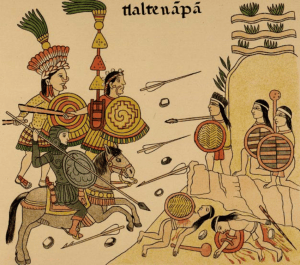
Spanish cavalry fighting with Tlaxcalan indios against indigenous opponents. From the Lienzo de Tlaxcala, folio 61, dated about 1522; redrawn by Alfredo Chavero c. 1890. https://www.researchgate.net
In areas where the Indians refuse to accept Christian doctrine peacefully, the following procedure may be used. An arrangement should be made with the principal lord who is a proponent of peace so that he will invite the belligerent Indians to his territory on one pretext or another. On this occasion the preachers, together with some Spaniards and friendly Indians, should be hidden nearby. At the opportune moment they should disclose themselves and begin teaching the faith with the aid of interpreters. In order that the Indians may hear the faith with greater awe and reverence, the preachers should carry the Cross in their hands and should be wearing at least albs or stoles; the Christians are also to be told to listen to the preaching with great respect and veneration, so that by their example the non-believers will be induced to accept instruction. If it seems advisable, the preachers may attract the attention of the non-believers by using music and singers, thereby encouraging them to join in. If the Indians seem inclined to be peaceful and request the preachers to go to their territory, the latter should do so, taking the precautions previously described. They should ask for their children under the pretext of teaching them and keep them as hostages; they should also persuade them to build churches where they can teach so that they may be safer. By these and other means are the Indians to be pacified and indoctrinated, but in no way are they to be harmed, for all we seek is their welfare and their conversion.
Once the region has been pacified and the Indian lords and subjects have tendered us their fealty, the Governor, with their consent, is to distribute the land among the settlers who are to take charge of the natives in their parcels, defending and protecting them and providing them with clerics to teach them Christian doctrine and administer the sacraments. They should also teach them to live in an orderly fashion and fulfill all the obligations of encomenderos as set forth in the clauses dealing with this subject.
The Indians who offer us obedience and are distributed among Spaniards are to be persuaded to acknowledge our sovereignty over the Indies. They are to give us tributes of local produce in moderate amounts, which are to be turned over to their Spanish encomenderos so that the latter may fulfill their obligations, reserving to us the tributes of the principal villages and the seaports, as well as an amount adequate to pay the salaries of our officials. If it appears that the pacification of the natives will be accomplished more easily by temporarily exempting them from tribute payments or by granting them other privileges, this should be done; and whatever is promised should be carried out. …

