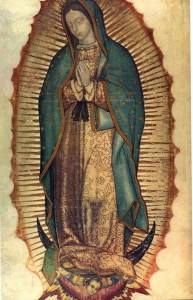
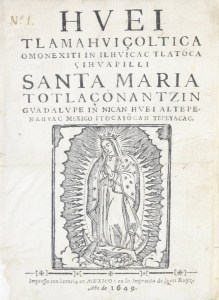
The priest Luis Lasso de la Vega was appointed vicar of the shrine of Tepeyac/Guadalupe in 1647, a small chapel that housed a prized image of the Virgin Mary. When Lasso de la Vega read his fellow priest Miguel Sánchez’s book (in Spanish), The Image of the Virgin Mary Mother of God of Guadalupe (1648), the first published account of a miraculous supernatural apparition to the indigenous peasant Juan Diego—an event Sánchez located 117 years earlier, in 1531—Lasso remarked approvingly and enthusiastically. The reader, he said, feels akin to Adam waking in paradise and discovering the newly created Eve: “I and all my predecessors have been like sleeping Adams, [unknowingly] possessing this second Eve in the paradise of their Mexican Guadalupe.” The following year Lasso wrote and published his own account, this one in the native Nahuatl language—Huei tlamahuiçoltica (or The Great Happening).
The image and the story of the Virgin of Guadalupe have had a long and powerful symbolic engagement with the religion, spirituality, and cultures of New Spain/ Mexico and other regions of the Americas. What does reading this 17th-century account of an event that purportedly belonged to the early 16th-century colonial history of New Spain help us to see about the experience of Mexico’s indigenous people in their encounters with colonial power and Catholic piety?
SOURCES: Harriet de Onis, ed. and trans., The Golden Land: An Anthology of Latin American Folklore in Literature (New York: Alfred Knopf, 1948), 72-78.
Ten years after the capture of the city of Mexico, the wars came to an end, and there was peace in the land, and the faith began to spread, the knowledge of the true God in whom we live. About this time, in the year 1531, early in the month of December, there was a poor Indian, called Juan Diego, so it is said, a native of Cuautitlán. It was a Saturday, very early in the morning, and he was on his way to church and to do some errands.
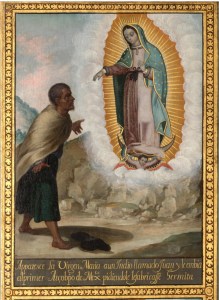
Detail from Image and Apparitions of Our Lady of Guadalupe (1656) by José Juárez (1617-1661)
When he reached the hill known as Tepeyacac, day was breaking, and he heard the sound of singing on the hill; it was like the song of many sweet-voiced birds; at times the singers fell silent, and it seemed as though the hills were answering. The song, so sweet and pleasing, was lovelier than that of the coyoltototl and the tzinizcan and of other singing birds. Juan Diego stopped to look and said to himself: “Am I hearing right? Perhaps I am still asleep? Have I awakened? Where am I? Could I be in the earthly paradise our forefathers told of? Or could I be in heaven?” He was looking eastward, to the top of the hill, whence the heavenly music was coming, when it suddenly ceased, and there was a silence, and he heard someone calling to him from the summit of the hill and saying: “Juanito, Juan Dieguito.” So he proceeded to where the voice came from; he was not at all frightened, on the contrary, very happy, and he climbed the hill to see who was calling him. When he reached the top he saw a lady standing there, who told him to come near her. When he approached her he was amazed at her superhuman grandeur: her raiment was resplendent like the sun; the rock on which her foot rested was shot through with radiance, and was like an anklet of precious stones, and the earth all around shone like the rainbow. The mesquites, cactus, and other little plants growing there were like emeralds, their foliage beautiful turquoise, and their branches and thorns gleamed like gold. He bent low before her and heard her speak, in a gentle, polite tone, as though to manifest her love and esteem: “Juanito, littlest of my sons, where are you going?” He answered: “Lady and Niña mia, I am on my way to your house in Mexico Tlatilolco, to follow the divine teachings given and taught us by our priests, the representatives of Our Lord.” Then she spoke to him and revealed her holy desire. She said to him: “Know the Mother of the True God in whom we live, of the Creator in whom all exist, Lord of Heaven and Earth. I greatly desire that a temple be built me here, that in it I may manifest and give to all my love, pity, help, and defense, for I am your mother, yours and all the dwellers in this land and the others who love me and call upon me and trust in me; here I will listen to their pleas, and remedy their sufferings, griefs, and pains. And to carry out the desire of my clemency, go to the palace of the bishop of Mexico and tell him that I have sent you to reveal to him what I earnestly desire, that here on this spot a temple be erected to me. Describe to him carefully all that you have seen and admired, and what you have heard. Rest assured that I will be very grateful and will repay you, for I will make you happy, and you will deserve that I recompense the effort and the trouble you undergo to do what I ask of you. You have heard my bidding, littlest of my sons; go now and do as I have said.” At once he bowed low before her and said: “My Lady, I go to do your errand; for the present I take my leave of you, I, your humble servant.” And he went down the hill to do as he was bid, and came out on the highway that follows a straight line into the city of Mexico.
When he reached the city he went without delay straight to the palace of the bishop, who had been appointed only a short while before, by name Fray Juan de Zumárraga, of the order of St. Francis. As soon as he got there he tried to see him; he begged the servants to announce him, and after a considerable time had elapsed, they came to call him, saying the bishop had said he should come in. As soon as he entered, he bowed and knelt before him, and proceeded to give him the message from the Lady of Heaven. He also told him of the wondrous thing he had seen and heard. After listening to all he had to say, the bishop seemed skeptical, and answered him: “Come again some other time, son, and we’ll talk this over more slowly; I will hear all you have to say from the beginning, and consider the message and desire with which you have come.” Juan Diego departed sadly, because he had in no wise accomplished his errand.
He went back the same day and climbed to the summit of the hill where he came upon the Lady of Heaven, who was waiting for him right where he had seen her the first time. …
“ … I beg you, Lady and Niña mia, to pick out some important person who is known and respected to carry your message, so they will believe him. Because I am just a little man, a bit of rope, a frail wooden ladder, a fallen leaf, a nobody, and you, Niña mia, littlest of my daughters, My Lady, send me to a place where I am not in the habit of going and don’t belong. Forgive me for causing you sorrow and arousing your anger, My Lady and Beloved.” The Blessed Virgin answered: “Listen, oh littlest of my sons, know that my servants and messengers are many whom I could entrust to bear my message and do my will; but it is absolutely necessary that you, and you alone, solicit what I wish, and that my will be done through your mediation.” …
The next day, which was Sunday, very early in the morning, he left his house and went straight to Tlatilolco, to hear the divine teachings, and to be there when they took the roll, and see the bishop afterwards. At about ten o’clock, after Mass had been said, and the roll taken, and the people had left, Juan Diego went to the palace of the bishop. After many difficulties he was admitted to his presence. He knelt at his feet, and grew sad and wept as he told him of the command of the Lady of Heaven, saying he hoped he would believe his message, and the will of the Immaculate, that a temple should be built to her in the place she desired. The bishop, to certify himself, asked him many things, where he had seen her, what she was like; and he carefully related everything to the bishop. He even described with great exactness how she looked, and all that he had seen and had wondered at, and in everything it was apparent that she was the ever Virgin Blessed Mother of the Saviour, Our Lord, Jesus Christ. Nevertheless the bishop did not believe him, and told him that not merely because of his talk and desire could his wish be fulfilled; that, in addition, he would have to have some sign to show that he was sent by the Queen of Heaven. As soon as he said this, Juan Diego replied to the bishop: “Sir, tell me the sign you want; and I will go at once and ask the Queen of Heaven, who sent me here, for it.” When the bishop saw that he ratified all he had said without hesitating or retracting anything, he dismissed him. He immediately ordered some of the members of his household whom he could trust to follow him and watch carefully where he went and whom he met and talked with. And this was done. Juan Diego set straight out on the highroad; those who were following lost him near the bridge of Tepeyacac, where the ravine is, and although they looked everywhere for him, they could not find him. And they returned, angry at not having accomplished what they set out to do, but desirous of preventing Juan Diego from carrying out his plan. They went to see the bishop, to persuade him to pay him no heed; they told him that he was deceiving him, that he was inventing what he told him, or at any rate he had dreamed it. And they decided that if he came back again, they would punish him severely to teach him not to lie and deceive.
Meanwhile, Juan Diego was with the Blessed Virgin, telling her what the bishop had answered. After the Lady had heard him, she said: “It is well, my son. Tomorrow you will return here and take the bishop the sign he has asked for; with this he will believe you and will no longer doubt or distrust your word. And know, my son, that I will repay your diligence and the effort and fatigue you have endured for me. Go now, and I will be waiting for you here tomorrow.” …
After the merciful Virgin had heard Juan Diego’s words, she replied: “Listen and hearken to me, littlest of my sons. This that frightens and distresses you is nothing. Let not your heart be troubled. Have no fear of this sickness or of any other sickness or trouble. Am I, your mother, not here? Do you not stand in my shadow? Am I not your health? Are you not in my lap? What more do you need? Let nothing sadden or afflict you; have no concern for the illness of your uncle, who will not die now. Know that he is already cured.” …
“Go up, littlest of my sons, to the top of the hill; there where you saw me and I gave you my orders you will find many flowers. Cut them, gather them up, and then come back to me with them.” Juan Diego immediately climbed the hill, and when he reached the top he was amazed to see that many different roses of Castile had bloomed there before the season for them, because it was bitter cold at the time. …
When she saw them, she picked them up in her hand and then put them in his lap again, saying: “Littlest of my sons, these roses are the proof and token you will take to the bishop. Tell him in my name that they are evidence of my desire, which he must fulfill. You are my ambassador, worthy of confidence. I strictly order you not to open your blanket and reveal its contents to anyone but the bishop.” …
When he reached the bishop’s palace, the butler and the other servants of the prelate came to meet him. He told them to tell the bishop he wished to see him, but none of them would do it, pretending that they had not heard him, either because it was too early, or because they already knew him, and found him troublesome and importunate; besides, companions, who had lost sight of him when they tried to follow him, had already told them about him. For a long time he waited. Finally when they saw that he had been there a long time, standing, and with his head bowed, waiting patiently to see if he were sent for, and as it seemed that he was carrying something in his blanket, they drew near him to find out what it was and satisfy their curiosity. When Juan Diego saw that he could not hide what he was carrying, and that on this account they would upbraid him, or push him or beat him, he opened the blanket a little and showed the flowers. When they saw the different roses of Castile when it was not the season in which they bloomed, they marveled greatly to see them so fresh, so full-blown, so fragrant and so beautiful. They reached in to take some of them from him, but the three times they tried, they were unsuccessful, for when they went to touch them, they did not find real flowers, but they seemed painted or embroidered or worked in the blanket. They went at once to tell the bishop what they had seen, and to ask him to receive the little Indian who had come so many times and who had been waiting a long while to see him. When the bishop heard this, he realized that the Indian had come with the proof he had demanded. …
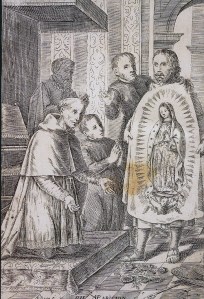
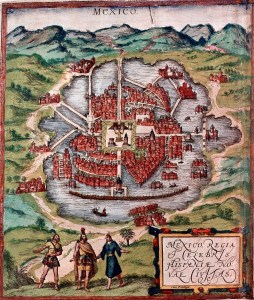
Engraving from the work “Felicidad de México” published in 1666 in Spain.
“She told me why I was to give them to you; and I am doing so that you may see in them the sign you asked for and accomplish her will; and also that you may see the truth of my word and my message. Here they are; receive them.” Then he unfolded his white blanket in which he was carrying the flowers. And as the different roses of Castile poured out on the floor, on the blanket there suddenly appeared the precious image of the ever Virgin Blessed Mary, Mother of God, as it is preserved today in her temple of Tepeyacac, which is called Guadalupe. When the bishop saw it, he and all those present knelt down; they marveled greatly at it; they arose to see it; they grew sad and grievous, showing that they were looking upon it with heart and mind. The bishop, with tears in his eyes, prayed and begged her forgiveness for not having carried out her wish and her command.

