Bartolomé de Las Casas (1484-1566) was a child in Seville when Christopher Columbus first returned to Spain and was enthusiastically celebrated for discoveries of territory dubbed “the Indies” and claimed as territory to be overseen by the Catholic rulers of Spain (specifically Isabella of Castile). As an adult, Las Casas became a colonizer-settler in the Spanish-ruled Caribbean islands before becoming a priest, a Dominican friar, and eventually a passionate advocate for the rights and well-being of the indigenous people of the “New World.”
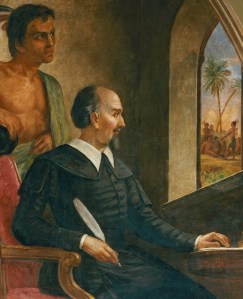
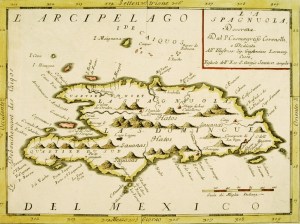
The three selections that follow supply his perspective, as witness to the conquests and exploitation of land and people by Spanish adventurers, on the experience of the indigenous people of Hispaniola, Cuba, and Mesoamerica who suffered the effects of Spanish and Catholic pursuit of wealth and the expansion of the faith. The first selection (I) is taken from the influential work released in his own lifetime, A Short Account of the Destruction of the Indies (finished in 1542 but not published until 1552). In this account, Las Casas wrote in a prophetic vein, attempting to dramatize the plight of people brutalized by the inhuman actions of Europeans whose Christian identity was cast into doubt by their practice. As a clear advocate of native people and critic of Spanish policies, Las Casas was not seeking to appear neutral or dispassionate. For that reason, some historians have warned readers to remember the writer’s agenda when assessing the historical reliability of his testimony. The second and third selections are taken from the historical narrative Las Casas began writing in 1527 and finished in 1565, History of the Indies. (It would remain unpublished until 1875-1879.) Selection II gives a general account of the encomienda/repartimiento or forced labor system, and selection III speaks to the beginnings of clerical critique of and resistance to the abuses forced on indigenous laborers by colonial settlers. While Catholic clergy were resident in the early Spanish settlements on the island of Hispaniola as early as 1503, Las Casas notes that productive engagement with the horrific experience of native people did not begin until Dominican friars arrived in 1511. Although he himself was not an eyewitness to the event, he gives a detailed account of the uncomfortable experience for encomenderos of having to listen to Fr. Antonio Montesinos’s Advent sermon denouncing their treatment of the people the Spanish called “Indians.”
Because of the value of his voice and witness, Las Casas was designated “Protector of the Indian” by Cardinal Ximénes de Cisneros (then regent of Spain) in 1516 and was appointed the first Bishop of Chiapas in New Spain (“Mexico” and bordering Guatemala) in 1544.
SOURCES: (I) Bartolomé de Las Casas, A Short Account of the Destruction of the Indies, ed. and trans. Nigel Griffin (London: Penguin Books, 1992), 9-11, 13, 27-29. (II) Bartolomé de Las Casas, History of the Indies, ed. and trans. Andrée Collard (New York: Harper & Row, 1971), 109-115. (III) Bartolomé de Las Casas. Historia de las Indias [1565], 2:441-42, trans. Benjamin Keen in Robert Buffington and Lila Caimari, eds., Keen’s Latin American Civilization: History and Society, 1492 to the Present, 8th ed. (Boulder, Colorado: Westview Press, 2004), 77-78.
(I) A Short Account of the Destruction of the Indies
The Americas were discovered in 1492, and the first Christian settlements established by the Spanish the following year. It is accordingly forty-nine years now since Spaniards began arriving in numbers in this part of the world. …
They [the peoples of this area] are innocent and pure in mind and have a lively intelligence, all of which makes them particularly receptive to learning and understanding the truths of our Catholic faith and to being instructed in virtue; indeed, God has invested them with fewer impediments in this regard than any other people on earth. …
It was upon these gentle lambs, imbued by the Creator with all the qualities we have mentioned, that from the very first day they clapped eyes on them the Spanish fell like ravening wolves upon the fold, or like tigers and savage lions who have not eaten meat for days. The pattern established at the outset has remained unchanged to this day, and the Spaniards still do nothing save tear the natives to shreds, murder them and inflict upon them untold misery, suffering and distress, tormenting, harrying and persecuting them mercilessly. … When the Spanish first journeyed there, the indigenous population of the island of Hispaniola stood at some three million; today only two hundred survive. …
The reason the Christians have murdered on such a vast scale and killed anyone and everyone in their way is purely and simply greed. They have set out to line their pockets with gold and to amass private fortunes as quickly as possible so that they can then assume a status quite at odds with that into which they were born. Their insatiable greed and overweening ambition know no bounds; the land is fertile and rich, the inhabitants simple, forbearing and submissive. The Spaniards have shown not the slightest consideration for these people, treating them (and I speak from first-hand experience, having been there from the outset) not as brute animals – indeed, I would to God they had done and had shown them the consideration they afford their animals – so much as piles of dung in the middle of the road. They have had as little concern for their souls as for their bodies, all the millions that have perished having gone to their deaths with no knowledge of God and without the benefit of the Sacraments. One fact in all this is widely known and beyond dispute, for even the tyrannical murderers themselves acknowledge the truth of it: the indigenous peoples never did the Europeans any harm whatever; on the contrary, they believed them to have descended from the heavens, at least until they or their fellow-citizens had tasted, at the hands of these oppressors, a diet of robbery, murder, violence, and all other manner of trials and tribulations. …
One of the leading local lords, a cacique[1] who went by the name of Hatuey, had fled to the island [of Cuba] from Hispaniola with many of his people in order to escape the miseries that arose from the inhuman treatment meted out to the natives of that island by the Spanish. When he heard that the Christians had now switched their attention to Cuba, he gathered most if not all his people about him and addressed them, saying: ‘You know that rumour has it that the Christians are coming to this island, and you already know what they have done to the lord so-and-so and so-and-so and so-and-so. What they did on Haiti (which is another name for Hispaniola) they will do again here. Does any of you know why it is that they behave in this way?’ And when they answered him: ‘No, unless it be that they are innately cruel and evil’, he replied: ‘It is not simply that. They have a God whom they worship and adore, and it is in order to get that God from us so that they can worship Him that they conquer us and kill us.’ He had beside him, as he spoke, a basket filled with gold jewellery and he said: ‘Here is the God of the Christians. If you agree, we will do areitos (which is their word for certain kinds of traditional dance) in honour of this God and it may be that we shall please Him and He will order the Christians to leave us unharmed.’ …
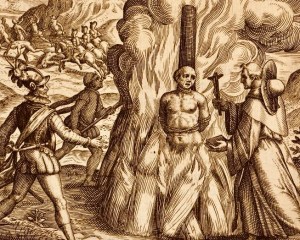
Detail of Dutch engraver Theodore de Bry’s (1528-1598) depiction of the execution of Hatuey at the hands of Spanish invaders of Cuba.
This same cacique and lord knew the Spaniards and their ways only too well and he fled from them once they arrived on the island of Cuba, only resorting to outright resistance when they actually tracked him down. But, eventually, he was captured and, although his only crime was that he had tried to escape the clutches of these cruel and iniquitous monsters because he knew only too well that they were out to kill him and that, if he did not defend himself, they would hound him and all his people to death, the Spaniards’ verdict was that he should be burned alive. Once he was tied to the stake, a Franciscan friar who was present, a saintly man, told him as much as he could in the short time permitted by his executioners about the Lord and about our Christian faith, all of which was new to him. The friar told him that, if he would only believe what he was now hearing, he would go to Heaven there to enjoy glory and eternal rest, but that, if he would not, he would be consigned to Hell, where he would endure everlasting pain and torment. The lord Hatuey thought for a short while and then asked the friar whether Christians went to Heaven. When the reply came that good ones do, he retorted, without need for further reflection, that, if that was the case, then he chose to go to Hell to ensure that he would never again have to clap eyes on those cruel brutes. This is just one example of the reputation and honour that our Lord and our Christian faith have earned as a result of the actions of those ‘Christians’ who have sailed to the Americas. …
(II) History of the Indies [Colonization, Encomienda, and the Treatment of Indigenous People]
1. I have already said and I repeat, the truth is that in the nine years the comendador governed the island, no measures were taken for the conversion of Indians and no more was done about the matter nor any more thought given to it than if the Indians were sticks, stones, cats or dogs.[2] This applies not only to the comendador and those who owned Indians but also to the Franciscan friars who had come with him. These were good people but they lived religiously in their houses here and in La Vega and had no other aspiration. One thing they did was brought to my knowledge: they asked permission to have the sons of some caciques (few of them to be sure), perhaps four, and taught them to read and write and I suppose their good example taught Christian doctrine, for they were good and lived virtuously.
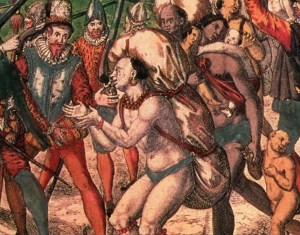
2. He disrupted villages and distributed Indians at his pleasure, giving fifty to one and a hundred to another, according to his preferences, and these numbers included children, old people, pregnant women and nursing mothers, families of high rank as well as common people. They called this system “Indian grants” (repartimientos) and the King had his grant and his manager in each town who worked his land and mined his part of the gold. The wording of the comendador’s Indian grants read like this: “Mr. X, I grant you fifty or a hundred Indians under the cacique X so that you may avail yourself of their services and teach them our holy Catholic Faith,” by which was meant, “Mr. X, I grant you fifty or a hundred Indians together with the person of the cacique X, so that you may use them in your lands and your mines and teach them our holy Catholic Faith.” And this was the same as to condemn them all to an absolute servitude which killed them in the end, as we shall see. This, then, was the nature of their freedom.
3. The men were sent out to the mines as far as eighty leagues away while their wives remained to work the soil, not with hoes or plowshares drawn by oxen, but with their own sweat and sharpened poles that were far from equaling the equipment used for similar work in Castile. […] Thus husbands and wives were together only once every eight or ten months and when they met they were so exhausted and depressed on both sides that they had no mind for marital communication and in this way they ceased to procreate. As for the newly born, they died early because their mothers, overworked and famished, had no milk to nurse them, and for this reason, while I was in Cuba, 7,000 children died in three months. Some mothers even drowned their babies from sheer desperation, while others caused themselves to abort with certain herbs that produced stillborn children. […] If this concatenation of events had occurred all over the world, the human race would have been wiped out in no time.
4. […] Our own eyes have seen such inhuman conduct several times and God is witness that whatever is said of it falls short of reality.
5. “Moderate labor” turned into labor fit only for iron men: mountains are stripped from top to bottom and bottom to top a thousand times; they dig, split rocks, move stones and carry dirt on their backs to wash it in rivers, while those who wash gold stay in the water all the time with their backs bent so constantly it breaks them; and when water invades the mines, the most arduous task of all is to dry the mines by scooping up pansful [sic] of water and throwing it up outside. […]
6. The comendador arranged to have wages paid as follows, which I swear is the truth: in exchange for his life of services, an Indian received 3 maravedís every two days, less one-half a maravedi in order not to exceed the yearly half gold peso, that is, 225 maravedís, paid them once a year as pin money or cacona, as Indians call it, which means bonus or reward. This sum bought a comb, a small mirror and a string of green or blue glass beads, and many did without that consolation for they were paid much less and had no way of mitigating their misery, although in truth, they offered their labor up for nothing, caring only to fill their stomachs to appease their raging hunger and find ways to escape from their desperate lives. […]
7. I believe the above clearly demonstrates that the Indians were totally deprived of their freedom and were put in the harshest, fiercest, most horrible servitude and captivity which no one who has not seen it can understand. Even beasts enjoy more freedom when they are allowed to graze in the fields. […]
8. This order[3] was difficult or impossible and not designed to bring Indians to the Faith; indeed, it was pernicious and deadly and designed to destroy all Indians. Obviously, the Queen had not intended the destruction but the edification of the Indians, and the comendador would have done well to consider this, as well as the fact that, had the Queen been alive to see the results of her order, she would have revoked and abominated it. It is amazing how this prudent man did not realize what a deadly pestilence his order was when, at the end of each shift, he found out how many Indians were missing and how the rest suffered.
As I said, the Queen died shortly after sending her warrant and therefore never found out about this cruel decimation. Philip and Juana succeeded her but Philip died before he could appraise the situation in the Indies and Castile was two years without the presence of a King. Thus, the decimation of these poor Indians had begun and could be kept silent, and when King Hernando came to rule Castile they kept it from him too. About eight years passed under the comendador’s rule and this disorder had time to grow; no one gave it a thought and the multitude of people who originally lived on this island, which, according to the admiral, was infinite, as we said in Book I, was consumed at such a rate that in those eight years 90 percent had perished. From here this sweeping plague went to San Juan, Jamaica, Cuba and the continent, spreading destruction over the whole hemisphere […]
(III) History of the Indies [The Dominicans and Fr. Antonio Montesinos]
Sunday having arrived,[4] and the time for preaching, Father Antonio Montesinos rose in the pulpit, and took for the text of his sermon, which was written down and signed by the other friars, “I am the voice of one crying in the wilderness.” Having made his introduction and said something about the Advent season, he began to speak of the sterile desert of the consciences of the Spaniards on this isle, and of the blindness in which they lived, going about in great danger of damnation and utterly heedless of the grave sins in which they lived and died.
Then he returned to his theme, saying: “In order to make your sins known to you I have mounted this pulpit, I who am the voice of Christ crying in the wilderness of this island; and therefore it behooves you to listen to me, not with indifference but with all your heart and senses; for this voice will be the strangest, the harshest and hardest, the most terrifying that you ever heard or expected to hear.”
He went on in this vein for a good while, using cutting words that made his hearers’ flesh creep and made them feel that they were already experiencing the divine judgment. … He went on to state the contents of his message.
“This voice,” said he, “declares that you are in mortal sin, and live and die therein by reason of the cruelty and tyranny that you practice on these innocent people. Tell me, by what right or justice do you hold these Indians in such cruel and horrible slavery? By what right do you wage such detestable wars on these people who lived mildly and peacefully in their own lands, where you have consumed infinite numbers of them with unheard-of murders and desolations? Why do you so greatly oppress and fatigue them, not giving them enough to eat or caring for them when they fall ill from excessive labors, so that they die or rather are slain by you, so that you may extract and acquire gold every day? And what care do you take that they receive religious instruction and come to holidays and Sundays know their God and creator, or that they be baptized, hear mass, or observe holidays and Sundays?
“Are they not men? Do they not have rational souls? Are you not bound to love them as you love yourselves? How can you lie in such profound and lethargic slumber? Be sure that in your present state you can no more be saved than the Moors or Turks who do not have and do not want the faith of Jesus Christ.”
Thus he delivered the message he had promised, leaving his hearers astounded. Many were stunned, others appeared more callous than before, and a few were somewhat moved; but not one, from what I could later learn, was converted.
When he had concluded his sermon he descended from the pulpit, his head held high, for he was not a man to show fear, of which indeed he was totally free; nor did he care about the displeasure of his listeners, and instead did and said what seemed best according to God. With his companion he went to their straw-thatched house, where, very likely, their entire dinner was cabbage soup, unflavored with olive oil…. After he had left, the church was so full of murmurs that… they could hardly complete the celebration of the mass.
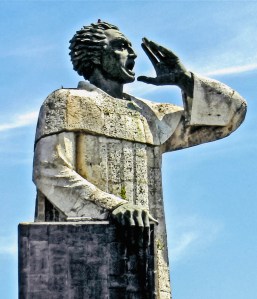
Monumental sculpture of Antonio Montesinos in Santo Domingo by Antonio Castellanos Basich.
[1] Cacique: From the Taino word “kasike,” a term for a local hereditary ruler or chieftain, the Spanish came to use this term for a variety of regional leaders.
[2] The comendador here is Fray Nicolás de Ovando (1460-1511), appointed Governor of the Indies by the Spanish rulers in 1502 to replace the Viceroy Francisco de Bobadilla in the crown’s quest for a more rigorous and lucrative colonial administration.
[3] “This order” refers to Queen Isabella of Castile’s 1503 mandate to Ovando to compel the labor and work for the conversion of the Taino people of Hispaniola: “… [I]n order that the Christians…may not lack people to work their holdings…and because we desire that the said Indians be converted to our Holy Catholic Faith…compel and force the said Indians to associate with the Christians…to work on their buildings, and to gather and mine the gold and other metals, and to till the fields and produce food for the Christian inhabitants…. This the Indians shall perform as free people, which they are, and not as slaves. And see to it that the said Indians are well treated, those who become Christians better than the others….”—quoted and translated by Lesley Byrd Simpson, The Encomienda in New Spain (Berkeley: University of California Press, 1929), 30-31.
[4] The third Sunday of Advent, 1511.
 History of Christian Experience II