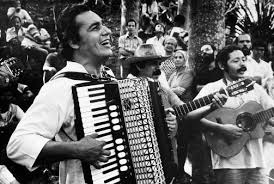
The Second Vatican Council’s liturgical reforms emphasized a greater degree of lay access and participation. In practice this meant not only liturgies in the language of the people, the vernacular, but liturgical connections to the everyday experience of lay worshippers. In Nicaragua, popular musician and performer Carlos Mejía Godoy (1945- ) utilized his experience traveling through the country and learning from workers and the poor in bringing to life a Catholic Mass to speak to God’s presence in and identification with the peasant (campesino) majority of Nicaragua. Mejía Godoy’s mass was written in the community of Solentiname in 1975.
SOURCE: Misa Campesina Nicaraguense. Words and music by Carlos Mejía Godoy and el Taller de Sonido Popular. Translated from the Spanish by Walter J. Petry. Sample the music (for the entrance hymn) here.
Entrance Hymn
You are the God of the poor,
the human and simple God,
the God who sweats in the streets,
the God with the weather beaten face;
therefore I speak to you
just as my people speak
because you are God the worker
Christ the laborer.
You go in hand with my people,
you fight in country and city,
you stand on line there in the field
to get your daily wage.
You eat snow cones there in the park
with Eusebio, Pancho and Juan José
and you even complain about the syrup
when that does not have enough honey.
I have seen you in the general store ensconced in a shed;
I have seen you selling lottery tickets
without your being ashamed of that job;
I have seen you in gas stations
checking the tires of a truck
and I have even seen you on the highways
with leather gloves and overalls.
Kyrie
Christ, Christ Jesus,
identify with us.
Lord, Lord my God,
identify with us.
Christ, Christ Jesus,
be in solidarity.
Not with the oppressor class
which exploits and devours
the community
but with the oppressed
with my people
who thirst for peace.
Gloria
With the happiest
music of my people I come to sing
this Gloria to Christ
which I prefer to the bullfight music.
I want to sing to Jesus
who is leader of truth
with the overflowing
and explosive joy of the rockets
which illuminate our skies
on our popular fiestas.
Glory to God in Siuna, Jalapa and Cosiguina,
and Solentiname, Diriomo and Ticuantepe.
Glory to God in Tisma, Waslala and Yalagüina,
and Totogalpa, Moyogalpa and Santa Cruz.
Glory to the one who follows the light of the Gospel,
to the one who denounces injustice without fear.
Glory to the one who suffers imprisonment and exile
and gives his life fighting the oppressor.
Today we glorify you, Lord, with marimbas,
with violins of námbar, sonajas and atabales,
with chirimillas, quijongos and sambumbias,
with the indigenous dances of Subtiava and Monimbó.
…
Creed
I firmly believe Lord
that from your generous mind
this entire world was born,
that from your artist-hand
as primitivist painter,
beauty has come to thrive:
the stars and the moon
the little homes, the lagoons,
the little boats sailing
on the river towards the sea,
the huge coffee plantations,
the white cotton plantations,
and the forests hacked up
by the evil hatchet.
I believe in you
architect, engineer,
artisan, carpenter,
mason, shipbuilder;
I believe in you
creator of thought,
of music and of the wind,
of peace and of love.
I believe in you, Christ the worker,
light of light and true
only-begotten son of God
who, to save the world
in the humble and pure womb
of Mary, became incarnate.
I believe that you were beaten
and with jeers tortured,
martyred on the cross,
Pilate being the praetor,
the Roman imperialist
malicious and soulless
who washing his hands
wanted to hide his fault.
I believe in you, compañero,
the Human Christ, the worker Christ,
Conqueror of death, who with immense sacrifice
engendered the new man
for liberation.
You are resurrected
in each arm that is raised
to defend the people
from exploitative rule,
because you are alive on the ranch,
in the factory, in school;
I believe in your fight without let up,
I believe in your resurrection.
Communion Hymn
Let us go to the milpa [= corn patch],
To the Lord’s milpa.
Jesus Christ invites us
to his harvest of love;
the cornfields shine
in the light of the sun,
let us go to the milpa
of Communion.
The people gather themselves
around the altar,
very close to the [divine] fire
the whole community meets together;
I come from the interior,
way beyond Sacaclí;
I bring pretty mazurquitas [songs]
and a pretty little tune which I sing
like this.
The little fish of the lake
want to accompany us
and jump around excitedly
as encalichados in brotherhood:
Lagoon fish and bass
the Guapote and the Gaspar,
the mojarras, the guabinas
and even the sardines seem to sing.
Communion is not a myth,
inconsequential and banal;
it is commitment and life,
a raising of Christian consciousness;
it is to share the fight
for community,
it says: I am Christian
and on me, brother, you can count.

