
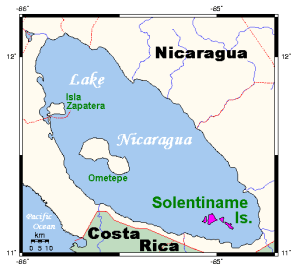
Ernesto Cardenal (1925-2020), a Catholic priest, Latin American poet, and Nicaraguan minister of culture (1979-1990) was best known for his work of founding and ministering (1965-1977) to a community of peasants and artists on the Solentiname Islands, an archipelago in Lake Nicaragua. The experience of this community fed into what Latin American liberation theologians called the “base community” movement—a movement also inspired by the work of Brazilian educator and philosopher Paulo Freire’s Pedagogy of the Oppressed (1968). At the beginning of Cardenal’s ministry, Nicaragua had in common with several other Latin American countries the experience of US-backed, authoritarian, more-or-less dictatorial rule that served the interests of ruling economic classes while doing nothing to alleviate the conditions of the poor. Anastasio Somoza (1925-1980), president in the 1960s and 1970s, was the last member of the family dynasty that had ruled the country since the 1930s.
Cardenal’s accounts of his ministerial-practical engagement with the Nicaraguan peasants of Solentiname was published in several volumes beginning in 1975. The dialogical pedagogy and experientially-grounded hermeneutic as described by Cardenal came to characterize the methods of liberation theology as the movement spread through South American communities. For better or for worse, Cardenal’s descriptions of the growth of revolutionary consciousness and commitment among his parishioners and comrades also focused readers’ attention on the association of liberation theology with anti-dictatorial, left-wing, and frequently Marxist-inspired political struggles. Note—especially in the Epilogue Cardenal penned in 1977 (after the demise of the community in the midst of the fighting that finally led to Somoza’s overthrow in 1979)—how Cardenal ruminated on the connections as well as tensions between his own contemplative spiritual roots and the activist-prophetic spirituality that led Christian peasants into revolutionary activity.
SOURCE: Ernesto Cardenal, The Gospel in Solentiname, vol. I, trans. Donald D. Walsh (Maryknoll, N.Y.: Orbis Books, 1982), l:vii-x, 260-65. Originally published as El evangelio en Solentiname, vol. 1 (Salamanca: Ediciones Sigueme, 1975). Ernesto Cardenal, “Epilogue,” in The Gospel in Solentiname [paperback edition), vol. 1, trans. Donald D. Walsh (Maryknoll, N.Y.: Orbis Books, 1982), 267-68, 270-71. Originally published as El evangelio en Solentiname, vol. 1 (Salamanca: Ediciones Sígueme, 1975).

“Oropendolas” by William González, artist on Solentiname.
In Solentiname, a remote archipelago on Lake Nicaragua with a population of campesinos, instead of a sermon each Sunday on the Gospel reading, we have a dialogue. The commentaries of the campesinos are usually of greater profundity than that of many theologians, but of a simplicity like that of the Gospel itself. This is not surprising: The Gospel, or “Good News” (to the poor), was written for them, and by people like them. …
Each Sunday we first distribute copies of the Gospels to those who can read. There are some who can’t, especially among the elderly and those who live on islands far away from the school. One of those who read best (generally a boy or a girl) reads aloud the entire passage on which we are going to comment. Then we discuss it verse by verse.
We use the Protestant translation entitled Dios llega al hombre, which is the best translation of the Gospels that I know. The translation is anonymous, but it was unquestionably made by a poet. It is in the simple language of the Latin American campesino, but it preserves a maximum fidelity to the Scriptures. …
The archipelago of Solentiname has thirty-eight islands; some are very small, and only the largest are inhabited. The population is about a thousand, composed of some ninety families. The houses are usually thatched huts, all spread out, some distance apart, on the shores of the different islands. …
Not all those who do come take an equal part in the commentaries. There are some who speak more often. Marcelino is a mystic. Olivia is more theological. Rebecca, Marcelino’s wife, always stresses love. Laureano refers everything to the revolution. Elvis always thinks of the perfect society of the future. Felipe, another young man, is very conscious of the proletarian struggle. Old Tomás Peña, his father, doesn’t know how to read, but he talks with great wisdom. Alejandro, Olivia’s son, is a young leader, and his commentaries are usually directed toward everyone, and especially toward other young people. Pancho is a conservative. Julio Mairena is a great defender of equality. His brother Oscar always talks about unity. The authors of this book are these people and all the others who talk frequently and say important things, and those who talk infrequently but also say something important. …
I am wrong. the true author is the Spirit that has inspired these commentaries (the Solenti-name campesinos know very well that it is the Spirit who makes them speak) and that it was the Spirit who inspired the Gospels. The Holy Spirit, who is the spirit of God instilled in the commu-nity, whom Oscar would call the spirit of community unity, and Alejandro the spirit of service to others, and Elvis the spirit of the society of the future, and Felipe the spirit of proletarian struggle, and Julio the spirit of equality and the community of wealth, and Laureano the spirit of the revolution, and Rebecca the spirit of Love.
Jesus a Cause of Division
(Matthew 10:34-37)
Before reading the passage we were going to comment on, Oscar had seen the title and exclaimed: “I don’t understand this! He came to bring unity. Why does it say here that he’s a cause of division. He’s supposed to be love!”
I said that first we ought to read it. We read this brief passage from Matthew, four verses, and went on to comment on them: Do not believe that I have come to bring peace to earth; for I have come to bring not peace but the sword.
Antenor said: “Injustice had always reigned on earth. He is coming to put an end to that state of affairs. So he’s coming to fight. But he’s not going to be fighting all alone. He does it with us.”
Marcelino: “He brought a very sharp weapon, which is his word. He brought that weapon for us. And it’s what we’re receiving here.”
One said: “Jesus is against being a conformist. That is why he said he didn’t come to bring peace.”
Another said: “There are people who want to live in peace, to have no problems.…’
And young Armando: “There are two kinds of peace. There’s a peace that’s simply to accept injustice, to remain quiet while the exploitation goes on. And there’s another peace, the one we get after we achieve justice, when things get straightened out.”
Laureano: “It seems to me that Jesus is teaching here that just because he was Jesus he wasn’t going to change things, bang!, to divide everything up. On the contrary, it’s up to us to fight so that we can have peace.”
Armando: “Because you have to fight to reach that peace, right?”
Laureano went on: “Yes, you have to fight hard in every country to get justice established throughout the world.”
Alejandro said: “Another thing that I see is that you can’t have peace if you really love your neigh-bor. Even when there’s peace in a community, like here in Solentiname, where life is peaceful and happy because we’re all at peace, even here, deep down you have the great worry, the uneasiness… because you see injustice more clearly. And the cause of this worry, I think, is love. And you can say, then, that this person is not completely at peace because he is concerned about others. And it would be too bad if we were all calm.”
Another said: “Since Jesus has come to bring a change, that is, a Revolution, he wasn’t coming to bring peace but war.”
I: “It’s clear that as long as there is a class of oppressors and a class of the oppressed, you can’t want to have peace between oppressors and oppressed, because that means to want to have oppression. But if we want the oppressed class to be freed so that there won’t any longer be oppressors and oppressed, then we really do not want peace.”
And Oscar said: “Ah, now I understand. What Jesus brought was unity for some but not for all.
For some-those who are on the side of love. He’s the cause of division because he’s the cause of unity.” I have come to set the man against his father, the daughter against her mother, the daughter-in-law against her mother-in-law: so that each one will have for enemies the members of his own family.
Laureano: “This seems to be against love, but as a matter of fact you shouldn’t always be stuck to your family, to your own kind. You should be for everyone, for your blood brothers as well as for those who aren’t your blood brothers, because these are your brothers too.”
Another of the boys said: “It happens sometimes that the father is an exploiter and the son is a good Christian and the son has to be against him.”
Antenor: “This division within families has to happen. And whenever there are new ideas that go against tradition, the parents are almost always in favor of the traditional ways and the new ideas are against them.”
Laureano: “As I see it here he’s setting the young against the old: the son against the father, the daughter against the mother, the daughter-in-law against the mother-in-law. It seems that Jesus sees that the division he’s going to cause in families will be mainly a division between generations. And it’s because the young people are the ones who are almost always with the Revolution, and not the old people.”
I said that that division in families of which Jesus spoke was seen clearly in Cuba at the time of the Revolution. Many families were divided, and whenever there is a Revolution this has to happen.
Leonel: “How long? Until we’ve reached unity, right? Because it can’t always be like that. Division happens so that later there will be unity, a final peace.”
Armando: “But meanwhile Jesus comes to break the unity of the family, which was considered a very sacred thing, and since the family is the basis of society he comes to upset all of society. Here he publicly declares himself a disturber of social peace.”
Antenor: “That business about the family I see also as a way of talking about the class struggle.” He who loves his father or his mother more than me is not worthy of me; and he who loves his son or his daughter more than me is not worthy of me.
One of the young men said: “There are a lot of people here who are too attached to their families.”
And Olivia, who hadn’t spoken up to then, said: “Jesus isn’t saying here that we have to love the God of heaven and forget about people, but that’s how it has been understood in our traditional religion. And so for example a man leaves his money to ‘God,’ as he says, because he’d rather leave it to God than to the poor. No, I think that when Jesus is talking about love for him, he’s putting himself in the place of the poor, and of our neighbor in general. And what he means is that we should love all people, all our neighbors, and not just those in our family.”
Another added: “To love God is to love your brother, isn’t it?”
And Laureano: “Your brother, but not your brother because he’s the son of your mother, but because he’s your brother who is everybody.” Felipe: “Some think they’re pleasing God with prayers or songs, but singing to God is loving your brother.”
And one of the girls: “It’s a matter of loving not only our family and your friends but of loving everybody, and that’s hard.”
Armando: “And speaking of the God of heaven-the God of heaven doesn’t exist, or at least the only way we can know him is as he is made flesh in other people.”
Felipe: “Anyone who loves other people, practically speaking, already knows God.”
I said that was exactly what Saint John said.
And Alejandro: “It’s because God is love. Anyone who loves knows him because he has known love.”
Julio: “The sword splits, divides, and now I see why he says that he brought the sword.”
Gloria: “The sword of love.”
Epilogue
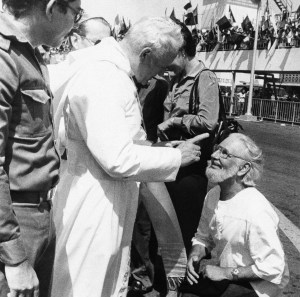
[A] Twelve years ago l arrived at Solentiname with two companions to found a small, contemplative community. Contemplation means union with God. We soon became aware that this union with God brought us before all else into union with the peasants, very poor and very abandoned, who lived dispersed along the shores of the archipelago.
[B] Contemplation also brought us to the revolution. It had to be that way. If not it would have been fake contemplation. My old novice master, Thomas Merton, the inspirer and spiritual director of our foundation, told me that in Latin America I could not separate myself from political strife.
In the beginning we would have preferred a revolution with nonviolent methods. But we soon began to realize that at this time in Nicaragua a nonviolent struggle is not feasible. Even Gandhi would agree with us. The truth is that all authentic revolutionaries prefer nonviolence to violence; but they are not always free to choose.
The gospel was what most radicalized us politically. Every Sunday in mass we discussed the gospel in a dialogue with the peasants. With admirable simplicity and profound theology, they began to understand the core of the gospel mes-sage: the announcement of the kingdom of God, that is, the establishment on this earth of a just society, without exploiters or exploited, with all goods in common, just like the society in which the first Christians lived. But above all else the gospel taught us that the word of God is not only to be heard, but also to be put into practice.
As the peasants of Solentiname got deeper and deeper into the gospel, they could not help but feel united to their brother peasants who were suffering persecution and terror, who were imprisoned, tortured, murdered, whose wives were violated and whose homes were burnt. They also felt solidarity with all who with compassion for their neighbor were offering their lives. For this solidarity to be real. they had to lay security, and life, on the line.
In Solentiname it was well known that we were not going to enjoy peace and tranquility if we wanted to put into practice the word of God. We knew that the hour of sacrifice was going to arrive.
This hour has now come. Now in our community everything is over. …
[C] But now brush will grow once again where our community used to be, just as it did before our arrival. There, there was a peasant mass, there were paintings, statues, books, records, classes, smiles of beautiful children, poetry, song. Now all that is left is the savage beauty of nature. I lived a very happy life in that near paradise that was Solentiname. But I was always ready to sacrifice it all. And now we have.
One day it happened that a group of boys and girls from Solentiname, because of profound convictions and after having let it mature for a long time, decided to take up arms. Why did they do it? They did it for only one reason: for their love for the kingdom of God, for the ardent desire that a just society be implanted, a real and concrete kingdom of God here on earth.When the time came these boys and girls fought with great valor, but they also fought as Christians. That morning at San Carlos, they tried several times with a loudspeaker to reason with the guards so they might not have to fire a single shot. But the guards [the Guardia Nacional, Somoza’s army] responded to their reasoning with submachine gunfire. With great regret, they also were forced to shoot.
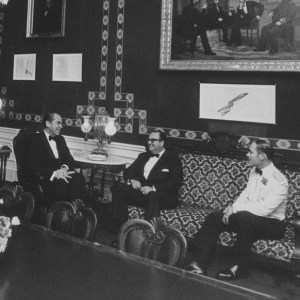
Nicaraguan President Anastasio Somoza at the White House with US President Richard Nixon and his Chief of Staff Gen. Alexander Haig, 1971.
Alejandro Guevara, one of those from my community, entered the building when in it there were no longer any but dead or wounded soldiers. He was going to set fire to it so that there would be no doubt about the success of the assault, but out of consideration for the wounded, he did not do it. Because the building was not burned, it was officially denied that it was taken. I congratulate myself that these young Christians fought without hate— above all, without hate for the wounded guards, poor peasants like themselves, also exploited. It is horrible that there are dead and wounded. We wish that there were not a struggle in Nicaragua, but this does not depend upon the oppressed people that are only defending themselves.

