Each of the assigned readings for today focuses on the encounter of Europeans/Westerners with Africans and their culture in the long colonial period—from the late fifteenth to the early twentieth century.
The first (originally assigned earlier in the semester) comes from Afonso I (reigned 1506-1543), ruler of the Kingdom of Kongo in the sixteenth century, a time of growing Portuguese commercial influence on the west African coast. (Kongo should not be confused with the more modern African states which were given the name Congo by later European colonial powers. Afonso’s territory today lies mostly within the bounds of the nation of Angola.) Afonso was a convert to Catholic Christianity—a conversion that created an alliance between Afonso and the Portuguese crown responsible for sending traders and representatives of the church into Afonso’s territory. The letter you are reading was written in 1514. It was one of a series of letters written to the king of Portugal. It reflects both Afonso’s significant hopes for the growth of the church in his territory and deep disappointment over the corruption apparent in the Europeans who poorly represented the faith he had enthusiastically embraced.
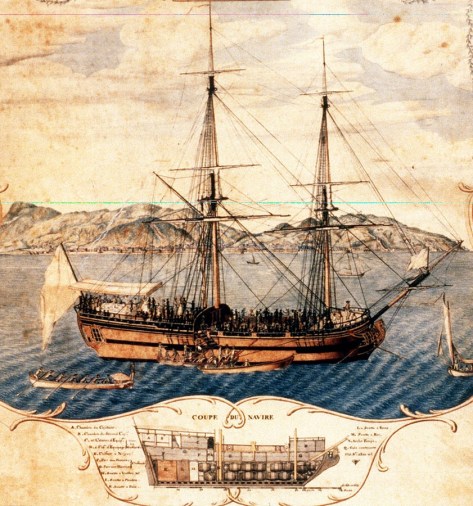 The second reading is a selection from Olaudah Equiano’s (c. 1745-1797) autobiographical The Interesting Narrative … (1789), one of the first narratives of the experience of a (former) slave to be published in the West. Equiano records his childhood among the Igbo people (mostly in what is today Nigeria), his capture and enslavement, and the treatment of enslaved people by European slave-traders. The narrative goes on to record his sale to two different owners, his extensive travels, and his conversion to Christianity. Equiano’s work is an early example of the collaboration in the West between evangelical Christianity and the anti-slavery movement—a collaboration that would lead to the importation of evangelical Protestantism into African territories in the nineteenth century.
The readings from Edward Wilmot Blyden (1832-1912) come from the later nineteenth century (1875, 1882). Blyden emigrated to Liberia (in West Africa) after a childhood in the West Indies (the Virgin Islands). He was a Presbyterian minister and became a prominent educator and statesperson in more than one West African country. In his writings, he reflects on the spirit of Western Christian mission to the African continent, as well as its methods and the actual outcomes. As you are reading, reflect especially on the following: What is Blyden’s attitude toward Christian mission? What methods does he prescribe for Christians wishing to spread the Christian faith in African contexts? What outcomes for Christian mission work (in Blyden’s own lifetime) do his writings testify to (successful, moderately successful, failing…)?
The final reading, from southern Presbyterian African American missionary William Sheppard (1856-1927), is an article published (in 1905) for an American audience. Sheppard gives a broad overview of his work among the Kuba people in territory that was claimed and colonized by the ruler of Belgium as the Congo Free State. He includes dramatic details of his work to befriend local rulers (the “Lukenga”) and establish mission stations and a successful missionary presence. Notice also his early report on atrocities committed by local (African) agents of the colonial (Belgian) regime that was seeking to extract as much rubber as possible from the territory through forced labor and a quota system. Sheppard’s reports helped to focus international attention on the plight of Congolese, leading to significant reforms. (The editor’s note at the end of the article betrays ignorance regarding Sheppard’s own position on the atrocities and their political context, as it reports with some satisfaction the arrest by “the state”—i.e., the colonial regime which was not friendly to Sheppard—of the Lukenga, who was in fact Sheppard’s and the mission’s ally. [The edited version you are reading omits the original editor’s note.])

