
Theologian, ethicist, theological educator, missionary and pastor Ada María Isasi-Díaz (1943-2012) founded the Hispanic Institute of Theology at Drew University where she served on the faculty of the School of Theology. Born in Havana, Cuba, she migrated to the USA as a political refugee in 1960. Serving for a time as a member of the religious Order of Saint Ursula, for whom she worked in mission in Peru in the 1960s, she came under the influence of the poor people with whom she ministered, the pioneering theological and ethical reforms of liberation theologians, and Christian feminist scholars and activists. When she earned advanced degrees in theology and ethics she began to articulate a liberation-focused theology that spoke particularly to and from the experience of Latinas—women of Latin and Hispanic background whose immigrant experience matched her own. The excerpts below are part of her ongoing project of laying out the project of such a theology, which she called “mujerista theology.”
SOURCE: Ada María Isasi-Díaz, La Lucha Continues: Mujerista Theology (Maryknoll, New York: Orbis, 2004). 240- 251, 264-266.
The Kyrie Eleison, a well-known prayer heard for centuries in the Roman Catholic Eucharistic liturgy, becomes a very different cry for mercy when it is uttered by those of us who are marginalized by society and suffer discrimination. A petition to an almighty and sovereign God to show mercy and forgive us our sins is trans-formed, in the Misa Nicaragüense, into a cry to Christ Jesus to identify himself with us and to be in solidarity with us instead of with those who destroy us. Vague requests for mercy become concrete: Christ Jesus, acknowledged as Lord but also addressed as a personal God—Dios mio—is asked to stand with us, to become one with us.[2] This request for him to join our ranks is not born out of a desire for personal solace and comfort. A private need would not result in a call for solidarity, which usually refers to a public stance taken to identify with and support oth-ers. What is at stake in this Kyrie is the need of the community for peace, the opposite, in this song, of being “squelched and devoured” by the oppressive class.[3]
Elaborating a Mujerista Christology
This prayer, this song, points to the mujerista understanding that theology is a praxis — that is, reflection-action that in a spiraling motion integrates the faith of Hispanas/Latinas with the struggle for liberation-fullness of life in which we are engaged in our daily living. Our religious beliefs direct and support action on behalf of liberation for ourselves and our people. Our actions, in turn, lead us to clarify what we believe: what it means for us in our everyday struggles against oppression to believe, for example, in Jesus as the Christ. Mujerista theology, recognizing the importance of religious beliefs in the lives of Hispanas/Latinas, seeks to elaborate a thcology that does not ignore the political and social realities of our life as a marginalized community within the USA. This reality of being marginalized within the most powerful country in the world nowadays is not simply a matter of location, of our mailing address. The marginalization of Hispanas/Latinas plays a substantial role in our theological-ethical enterprise and provides key elements to our theological praxis. Who is God for us who are pushed to the margins? How do we encounter God at the margins? Who is Christ for us, and how do we present Christ from the margins and to the margins?
What Hispanas/Latinas believe about Christ is not a matter of an applied doctrine, an application of what the churches teach. Our Christology is a praxis: what we believe about Christ comes out of our reality as marginalized Hispanas/Latinas, which is one of struggle for fullness of life. What we believe is, at the same time, a force that sustains this struggle. It is from within this praxis that mujerista Christology seeks to answer the question Jesus posed to his disciples, “Who do you say that I am?” (Mark 8:29). Jesus’ insistence on a personal answer from his disciples makes clear that what we must elucidate are not christological dogmas but rather the meaning Jesus has for Hispanas/Latinas in our daily lives at the beginning of the twenty-first century. Our Christology, as all Christology whether stated or not, is a historical one. We know Jesus is with us because he joins us in our struggle for liberation-fullness of life.
Our insistence on the historical character of mujerista Christology and on Christology as a praxis, leads to a third understanding: Christology, as is true of all religious beliefs, follows our ethical stance. In other words, human beings, previous to any religious thinking, form ideas about what is right and what is wrong, or, in religious language, what is sin and what is grace. Our consciences begin to be shaped well before the so-called “age of reason,” usually set around the age of seven. From a very carly age we begin to learn from those around us what is good and what is bad, By the time we begin to include the simplest understanding of Jesus in our thinking, the main patterns by which our consciences judge what we are supposed to do are already formed, These understandings “shape” what we believe about Jesus, In other words, when we begin to explicitly think religiously, we ascribe to Jesus or to God or to whatever concept of the divine we are beginning to form, the ideas we have elaborated about the good, At the personal level answers to questions like, “Who is Jesus?” “What does Jesus want me to do?” “What would Jesus do if he were here?” are not based on our knowledge of Jesus, It is the other way around; the answers we give these questions reveal to us what it is that our consciences are telling us, In this sense, what we believe about Jesus is a mirror for our consciences, For Christians this translates into the claim that, regardless of our protests to the contrary, belief follows practice, belief follows the patterns of goodness that have been deeply sown in our hearts and minds and that guide our daily lives.
A fourth understanding of mujerista theology is made explicit by the old custom of melding “Jesus” and “Christ” into one word: Jesucristo. The traditional understanding among theologians, although not among the common folk, is that “Jesus” refers to the historical person and “Christ” to what the church has taught us to believe about that Jesus. I propose that we take sen-ously the fusion of the two “names” and that we abandon the thought that we can find in the past what we need to know and believe today about Jesus and about Christ. In mujerista Christology we try to move away from the naïve understanding that we can historically reconstruct who Jesus was, how he understood himself, and what he did. We also try to move away from making normative those christological formulae from the past so heavily laden with historical and cultural understandings. We are indeed respectful of church teaching about Christ, but that is not our emphasis. The custom of folding into one word the name Jesus and the title Christ—Jesucristo—provides mujerista theology with the creative space needed to elaborate a Christology that responds to what Hispanas/Latinas believe about the message of Jesus of Nazareth. It does so precisely because it sustains and motivates us in our everyday struggles against what limits liberation-fullness of life and for all that promotes justice and peace, In this we fellow the established tradition of the Gospel writers who created narratives about Jesus that responded to the questions and issues that were alive in the communities for which they wrote. Our attempt to elaborate a mujerista Christology is part of our work to provide Hispanas/ Latinas with a religious narrative that can help us not only to understand our Christian faith but also to deal with the struggle for liberation-fullness of life that we face everyday, This struggle calls us to be creative, to offer explanations of who Jesucristo is for us in ways that have a certain logical flow and coherence. We have always refused to spend time deconstructing theological approaches or church reachings. The precariousness of our communities is such that we feel an urgency to create understandings that are useful in the work of liberation rather than thinking abour what was conceptualized in the past. Mujerista Christology listens carefully to the voices of grassroot Hispanas/Latinas knowing that they are admirably capable of reflecting on what they believe and of explaining it in ways that contribute to liberation-fullness of life.
Our Christology revolves around three key elements that emerge from the daily praxis of Hispanas/Latinas in the USA, that is, they are rooted in the way Hispanas/Latinas face everyday struggles for their fullness of life. First, Hispanas/Latinas hunger for deep, personal relationships to sustain us in our daily struggles, Second, we need God to help us take care of our people, not expecting God to solve our problems but rather asking Cod to be our faithful companion in our struggles. Finally, we know that only in so far as we become part of God’s family can we really say that we believe in Jesucristo.
Familia de Dios—The Kin-dom of God
The concept of the kingdom of God has undergone many transformations since it was first conceived by the Jewish people. Initially it was a concept based on the kingships that had enslaved them, Egypt and Babylon. It was the Iranian influence that provided “a transcendent feel, with the introduction of the end time, the idea of justice, and right living, which would bring about the security of the nation [Israel].”[5] Originally this understanding of transcendence did not project the “kingdom” —a new world order—into a different-world reality. “However, by the end of the first century C.E., a clear distinction emerged between this world, its end, and the setting in place of a new world order. For many people things that were believed to be possible in this world became transposed onto another place and time that were cter-nal and unchanging.”[6] This change in the way the kingdom of God was understood actually added to the despair about its realization in this world that followed the destruction of the Temple in Jerusalem in 70 C.E. Furthermore, projection of the realization of the kingdom of God into the next world allowed it to be conceived of as achievable only by God and achievable once and for all. “The psychic landscape changed significantly from a circle of hope, committed action, change, and back to hope for divine intervention and unchanging absolutes.”[7] As a result, from then on, the kingdom of God became an excuse for “nonengagement with the real stuff of life.”[8]
Unfortunately the split this created between this-world reality and the kingdom of God (kidnapped from this world and taken to a world yet to come) became useful for those in charge of the newly developing church. They determined the meaning and correct interpretation of all that was “Christian.” When in 313 C.E. the Edict of Milan legalized Christianity, the new religion began to gain political and economic power in addition to the religious and moral power over consciences it already held. The church became the only access to the kingdom of God in the world to come and its most powerful symbol in this world. Placing itself above the reality of this world and insulating itself against the vast majority of its members, the church came to link its life with the life of the established order, which it grew to resemble. Though it repeatedly claimed that its role was only religious, the church throughout its history has legitimized and supported those who have social, economic and political power. Historically it has become more and more a tool in the hands of the dominant groups in society. And the image and understanding of Christ have been affected sadly in the same way. Historically the image of Christ proclaimed by the church has seemed to float above human reality, nullifying the most precious meaning of the incarnation of God in Jesus of Nazareth. Christ little by little came to resemble monarchs and pontiffs with absolute power to whom the people only had access on bended knees. This Almighty Lord Jesus Christ was more like a feared judge demanding ever more from the people than he was like a loving mother welcoming and nurturing her children. It was only with the Second Vatican Council in the second half of the twentieth century that one finds meaningful movement in redrawing the meaning of the church and of the kingdom of God, with its great implications for Christology. The most relevant statement from the Second Vatican Council in reference to the relationship between the natural order and the supernatural order where the “kingdom of God” had been ensconced is found in Gaudium et Spes, no. 39. The text does not go far enough in relating the growth of the kingdom of God to temporal progress but, at lcast, the conciliar document affirms “a close relationship between temporal progress and the growth of the Kingdom. … Those engaged in the latter not only cannot be indifferent to the former; they must show a genuine interest in and value it.”[9] This step taken by Vatican II opened the door for considering theologically “temporal progress as a continuation of the work of creation” and, therefore, for seeing temporal progress as linked to the redemptive act of the life and mission of Jesus of Nazareth.[10 ]
The theological understanding that “the human work, the transformation of nature, continues creation only if it is a human act, that is to say, if it is not alienated by unjust socio-economic structures,”[11] developed by Latin American liberation theology, opens the possibility for rescuing the “kingdom of God” from the supernatural order. Various liberation theologies elaborated in the second half of the twentieth century make it clear that “kingdom of God” was the expression that Jesus used as the central metaphor for talking about his mission, for which he died on the cross. Every aspect of the life of Jesus related by the Gospels, every word ascribed to Jesus by the Gospels gyrates around the kingdom of God. In what he did and in what he said Jesus was always announcing the kingdom of God or denouncing the anti-kingdom, that is to say, the conditions that not only could not be present in the kingdom of God but that make the realization or coming of the kingdom of God impossible. Liberation Christologies, on the whole, tend to make of Jesus the “definitive mediator of the Reign of God,” claiming that he was “the person who proclaims the Reign, who posits signs of its reality and points to its totality.”[12] To claim that Jesus was the definitive mediator, they have to posit that who Jesus was and what Jesus said and did are central to the kingdom of God. But much more, it is not only a matter of Jesus and his life being central but also that they are essential. The claim is often made that only Jesus could grasp and live to the fullest what it means to be human. His role as definitive mediator, then, is not outside the realm of what is human but rather is “the fullness of the human.”[13] And this is precisely what we mean when we say that Jesus is Christ: that he lived to the fullest his humanity and the mission that it entailed. Because what Jesus did in reference to the kingdom of God is within the human realm, other persons can also be mediators, can also be Christs. As a matter of fact, to understand what Jesus meant by the kingdom of God and how he worked to make it a tangible reality, we have to understand that he stood in line with many other mediators of the kingdom, from Adam and Eve to his own mother, Mary of Nazareth. Furthermore, to understand Jesus and the kingdom of God he proclaimed with his life and deeds, we have to look carefully at the mediators of the kingdom that have lived since Jesus, who have committed themselves irrevocably to the kingdom of God, from the early men and women who were deacons, martyrs and confessors, to contemporary witnesses of the faith martyred or still alive.
All who commit themselves to proclaim with their lives and deeds the kingdom of God are mediators of the kingdom. Each and every one of us has the capacity and possibility of being another Christ, an alter Christus. Whether we are mediators of the kingdom of God does not have to do with our capacity to be mediators but rather with the choices we make in our lives, with our commitments, and also with the circumstances in which we live. Our mediation of the kingdom of God is related to the fact that understanding reality always includes dealing with reality. The kingdom of God does not exist apart from us who believe in it, nor does it “pass” through us without being affected by us and affecting us as well. All reality that we come into contact with is changed in some way by how we deal with it or ignore it because all that we do helps “to sustain a conception of the world or to modify it.”[14] And the same is true of the kingdom of God.
How does mujerista theology deal with the understanding that Jesus was the definitive mediator of the kingdom of God? If this claim indicates that no one can do it as he did it, then we can only agree, for no one can be someone else or do what others do the way they do it. But we can likewise claim that no one else, including Jesus, can do what each of us can do in mediating the kingdom of God. In this sense each of us is unique, as Jesus was. Each of us also mediates the kingdom of God in an essential way and in a way that would not happen without us. This is so because each and every one of us is an image of God, an imago dei: each and every one of us carries seeds of divinity that make who we are capable of being and what we are capable of doing essential to the unfolding of the kingdom of God. This is precisely one of the key reasons why we can rescue the kingdom from the other world and incarnate it once again in our midst. This is one of the most important reasons why we see our struggles in this world as part of the overall work of God’s creation. It continues in us and with us.
In the first-century Jewish world the metaphor of kingdom was the best way Jesus and his early followers found to indicate how people could encounter a benevolent God, one who would rule in their favor and for their sake. Kingdom was the best way in which they could talk about what values were determinant factors in the life of Jesus’ followers. But in today’s world the metaphor of the kingdom has become irrelevant because the reality that grounds the metaphor, actual kingdoms, rarely exists any more. Thus, the reference point of the metaphor is foreign to the experience of vast numbers of persons. For this reason alone church officials and theologians should use a different expression to signify the purpose of Jesus’ life and mission. However, there is more. The metaphor of kingdom is not only irrelevant; as it has traveled through time, it has lost much of the meaning it had for Jesus and his early followers, often providing room for anti-kingdom values. In mujerista theology we believe that the metaphor of kingdom is not appropriate since obviously it refers only to male sovereigns and reinforces once more the male image of God, still the most prevalent one in the church. In mujerista theology we believe kingdom is an ineffective and dangerous metaphor for it suggests an elitist, hierarchical, patriarchal structure that makes possible and supports all sorts of systemic oppressions. Given this reality, one of our tasks is to suggest other metaphors that speak cogently and effectively to twenty-first century persons.
To change root metaphors, one has to go into the content of the original one: what were the values ensconced in the metaphor kingdom of God when Jesus and his early followers used it? It was Jesus’ way of speaking about shalom, about fullness of life. Shalom was not a private reality that each individual had to find or construct. Rather, shalom was a reality for which people needed to work together. Therefore Jesus made love of neighbor central to life in the kingdom of God. Love is communal, the task of a people and not solely of individuals. Shalom—fullness of life —then, is the value at the heart of the metaphor that Jesus used and therefore has to be the central value in any metaphor we use to talk about Jesus’ understanding of his life and mission. Today, in mujerista theology, shalom goes by the name of liberation— a holistic liberation that happens at all levels of life: socially, politically, personally, spiritually.[15]
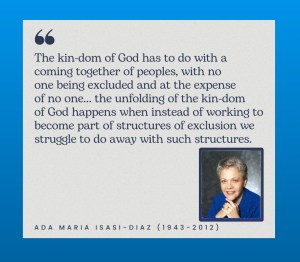
In mujerista theology we suggest replacing “kingdom” with “kin-dom.” We suggest moving from a political metaphor to which we have hardly any way of relating to a more personal metaphor that lies at the core of our daily lives. The idea of kin-dom of God, of the family of God, we suggest, is a much more relevant and effective metaphor today to communicate what Jesus lived and died for. This suggestion of the kin-dom of God is in many ways a response to the ongoing concern for the loss of family values and the loss even of a true sense of family in present-day society. Kin-dom of God as the core metaphor for the goal of Jesus’ life will help us to reconstitute our sense of family. Moreover, the picture of kin-dom of God that Jesus gives us is a broad one that has to do not exclusively with blood-relatives but also with those who are united by bonds of friendship, of love and care, of community. Mujeristatheologians bemoan the loss of family but we do not bemoan the loss of what has been called the traditional nuclear family. This so-called traditional nuclear family represents a very private and individualized group more set on defining and protecting its boundaries than in relating and welcoming all those that make life possible and pleasant for its members. The traditional nuclear family is a patriarchal setting where the man is considered the head, the one (perhaps the only one) most capable of representing and defending the family, of guiding and deciding for the family. This is why it is so difficult for society to imagine a family without a man or without a woman to complement the man. This is why we seem incapable of imagining same-sex parents or other than a biological parent carrying out the responsibilities of parenting. The traditional nuclear family in this highly technological industrial period in the USA in the first years of the twenty-first century is a family where relationships are less important than production and accumulation of capital and where if children are not better off economically than their parents, it is presumed that the family has failed. In mujerista theology we do not bemoan the disappearance of the traditional nuclear family.
The sense of familia that we have in mind when we talk about God’s family, the kin-dom, is one in which a true sense of home exists, a sense of belonging and being safe to be and become fully oneself. Familia provides for us a sense of unity and cohesiveness that promotes a healthy sense of self-identity and self-worth so important for the development of the person. Familia for us “is the central and most important institution in life.” 16 Whether personally familia is a life-giving structure for us, or unfortunately not a valuable one for whatever reason, familia is one of the key markers of our Latina communities. Familia is a marker not only of our position in life but also provides a clear indication of how we face life. Familia for us is a duty but also, for most of us, it is a never-failing support system. From a very young age, Latinas begin to understand that because of our families we do not have to face the world alone. We are also taught that precisely because the familia stands with us, we have a moral responsibility to each of its members who have invested so much in us by claiming us as their own. Who we are and what we do have personal repercussions for them. It is in the midst of familia and because of familia that at a very young age we are introduced to the ethical world of responsibilities and obligations, a world where one is because one is in relationship to others. In our families we learn that persons are more important than ideas and that, therefore, we have to take time and care to cultivate relationships.
Hispanas/Latinas’ sense of familia is an expansive and broad one, extending into the community in a formal way. Through the institution of compadrazgo and comadrazgo a system of relationships is established between godparents and their godchildren and the parents of their godchildren. But this system reaches beyond religious occasions, such as baptisms and confirmations, to secular activities and enterprises. Sponsors of dances, busi-nesses, and sports teams are called madrinas (godmothers) and/or padrinos(godfathers) for they not only provide monetary support but also supply vital connections with others to protect and promote the wellbeing of the organizations they sponsor.
Compadrazgo and comadrazgo create and sustain an effective infrastructure of interdependence that has the family at the center and extends family values such as unity, welfare and honor in all directions into the community.
Familia relies on interdependence, not subsuming the person but making one realize that the members of our families enable us to be who we are. Familia provides the security needed to extend ourselves into the community and form the kind of personal relationships that are vital to us without losing our sense of self. In our families we learn that “as in a prism, … reflection is also a refraction… [and that] the identity of the ‘we’ does not extinguish the ‘I’; the Spanish world for ‘we’ is ‘nosotros,’ which literally means ‘we others,’ a community of otros [and otras], or others.”[17]
It is true that Latina families are not perfect and that some of its characteristics are misguided and can cause damage to its members. We are not setting up Latina families and their relationships as the criteria for the biblical shalom. We are simply insisting on the need to change the metaphor traditionally used to refer to what Jesus’ life and mission was all about. Kin-dom of God points to what many would say is the central institution of all societies. Kin-dom embraces understandings and values that are intrinsic to liberation-fullness of life. To create and sustain an institution where we can be ourselves in a safe way, where our wellbeing is of primordial importance, where a new order of relationships excludes all exploitation and abuse— this is indeed the kind of family all persons would welcome, and relate to goodness, to blessedness, to God.
To the question “Who do you say that I am?” Hispanas/Latinas answer Jesus, “You are my brother, my sister, my mother and my father, my grandmother, aunt, uncle, comadre and compadre, who stands with me and who struggles with me. You are amazingly special to me because I am amazingly special to you. You are my big brother protecting me, and you are my little sister whom I protect. You are my husband, my wife, my partner, my significant other for whom I am precious and who loves me unconditionally. You and I are family, Jesus. What more can you be for me? What more do you want me to be for you?”
Notes
1 The Kyrie is part of the section of the Mass that deals with confession and forgiveness.
2 Carlos Meja Godoy y el Taller de Sonido Popular, “Kyrie,” in Misa Campesina.
3 The words of the song are as follows: “Christ, Christ Jesus, identify yourself with us. Lord, Lord, my God, identify yourself with us. Christ, Christ Jesus, be in solidarity with us, not with the oppressive class that squelches and devours the community, but with the oppressed, with my people who thirst for peace.”
4 Tom Driver, Christ in a Changing World (New York: Crossroad, 1981), 21-24.
5 Lisa Isherwood, Liberating Christ (Cleveland: Pilgrim Press, 1999), 133.
6 Ibid.
7 Ibid.
8 Ibid.
9 Gustavo Gutiérrez, A Theology of Liberation, 2nd ed. (Maryknoll, N.Y.: Orbis Books, 1988), 99.
10 Ibid., 100-101.
11 Ibid., 101.
12 Jon Sobrino, “Systematic Christology: Jesus Christ, the Absolute Mediator,” in Mysterium Liberationis: Fundamental Concepts of Liberation Theology, ed. Ignacio Ellacuría and Jon Sobrino (Maryknoll, N.Y.: Orbis Books, 1993), 441.
13 Ibid., 442.
14 Antonio Gramsci, Prison Notebooks, ed. and trans. Quintin Hoare and Geoffrey Nowell Smith (New York: International Publishers, 1975), 9.
15 I am always apprehensive when any list is drawn, for lists are almost always read as if the elements in them could be isolated one from the other. I want to insist on the fact that the struggle for liberation is a holistic struggle, that we cannot be liberated socially, for example, without being liberated personally— within ourselves (psychologically) as well as socially (in our personal relationships). I want to insist especially on the fact that “spiritually” is not a category set apart —that spiritual is intrinsic to the category marked “personally.” Here by spiritual I mean simply that the struggle for liberation also has to do with how we relate to God, a God that lives and moves and is among us, in us, a God that is in the social, in the political as well as in the personal.
16 Roberto R. Álvarez, Jr., “The Family,” in The Hispanic American Almanac, ed. Nicolas Kanellas (Washington, D.C.: Gale Research, 1993), 155. The claims Hispanas/Latinas make regarding family are in no way unique but that they are not unique does not mean that they are not specifically ours.
17 Roberto Goizueta, “Nosotros: Toward a U.S. Hispanic Anthropology,” Listening—Journal of Religion and Culture 27:1 (Winter 1992): 57.

